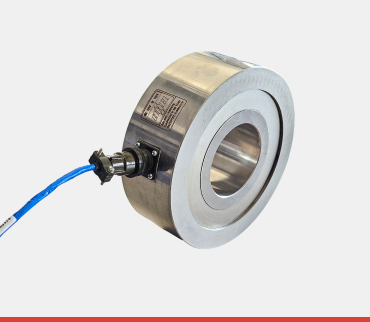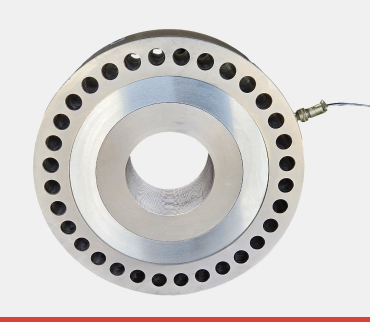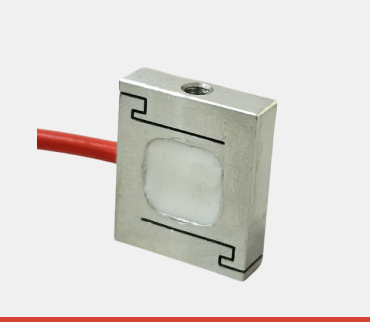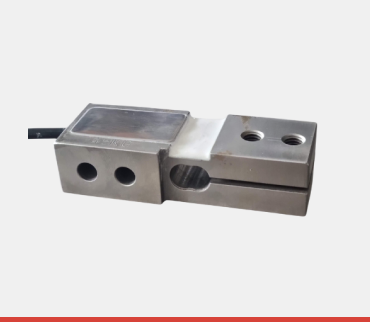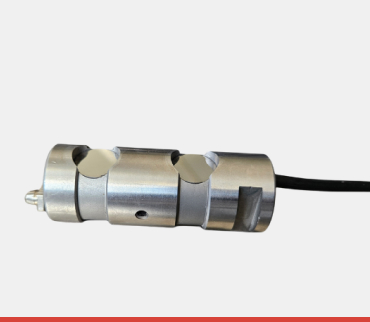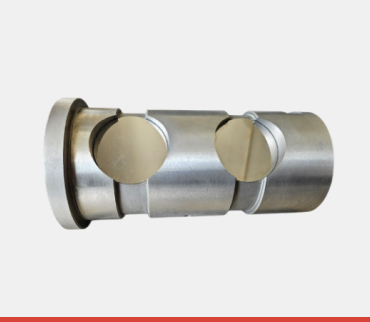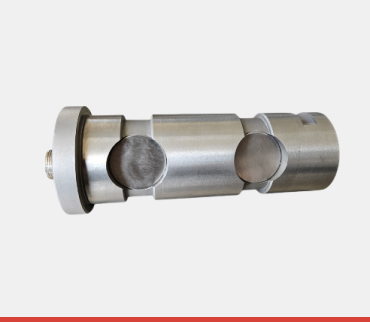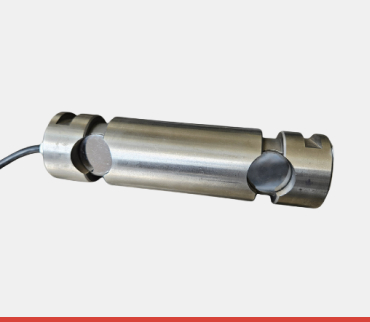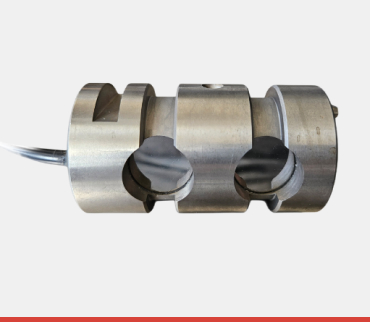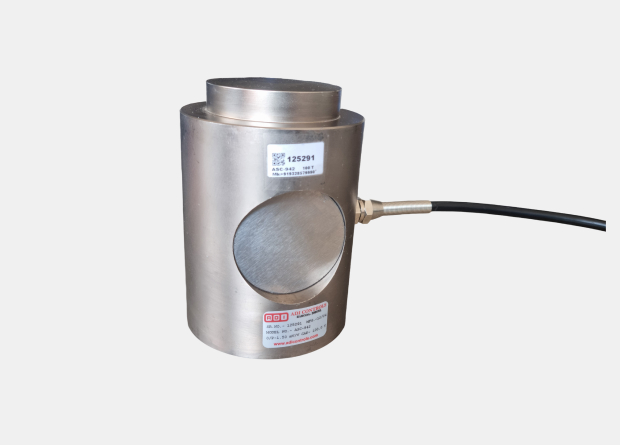
ADI ASC-942 canister type load cell (sometimes called a column load cell or compression load cell) is a robust force sensor designed primarily for measuring large compressive loads. It has a cylindrical, or canister-like shape with a flat top and bottom. These cells are optimized almost exclusively for compression (pushing) forces and are known for their high capacity and stability. The load is typically applied to the center of the top surface, which compresses the internal sensing element (often a column or shear web arrangement). Strain gauges bonded inside the canister measure the resulting axial deformation. Due to the harsh industrial environments they often operate in (like under silos or bridges), they are usually hermetically sealed (welded) or highly protected to provide excellent ingress protection (IP rating) against dust and moisture.
Product Type
Single Point Aluminium Load Cell
Usage
Table top scales, Counting and postal scales, Check weighers.
Material
Aluminium
Output
Analog Sensor
Theory
Resistance Sensor
Compensated Temperature
10 To 60 Celsius (oC)
Rated capacity (NM)
5, 10
Excitation Voltage
10 V DC – Maximum 15 V DC
Full Scale Output
2.0 mV / V
Non – Linearity
<± 0. 1 % FSO (Full scale Output)
Hysteresis
<± 0.1% FSO
Non-Repeatability
<± 0.1 % FS0
Creep error (30 minutes)
<± 0.3% FSO
Zero Output
± 1.0 % FSO
Input Resistance
392 ± 10 Ohms
Output Resistance
392 ± 10 Ohms
Insulation Resistance
>1000 Mega Ohms
Safe Overload
150 % of Rated Capacity
Ultimate Overload
250 % of Rated Capacity
Temperature
Compensated Range
10 to 60°C
Temperature Effect at Full Load
<0.05 % FSO/° C
Temperature Effect on
Zero
<0.05 % FSO/° C
Environment Protection
IP 65
Finish & Construction
Stain Less Steel 17-4 PH
Rotational Angular Deflection
< 0.2 at FSO
The most common type, the strain gauge load cell, works on the principle of the Wheatstone bridge circuit:
Load cells and the weighing systems they are part of require periodic calibration. While the load cell itself is a stable measuring element, calibration is necessary to ensure the entire system (cell + mounting hardware + electronics) is accurate.
Creep is defined as the change in the load cell’s output signal over time (t) while the applied load remains constant and all environmental factors (temperature) are stable.
WhatsApp us