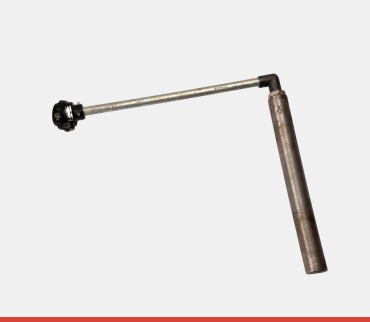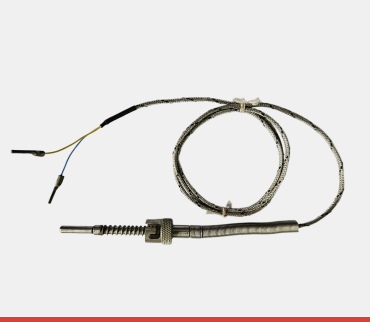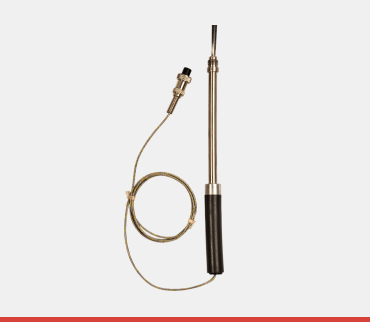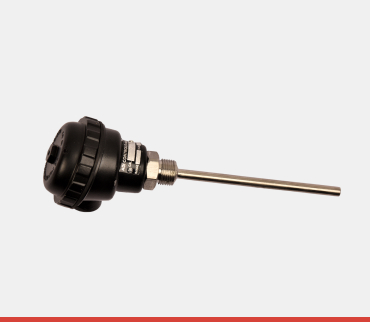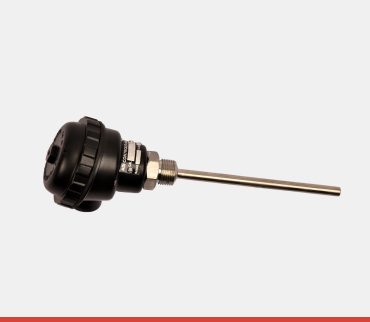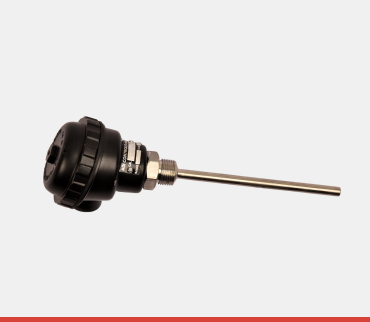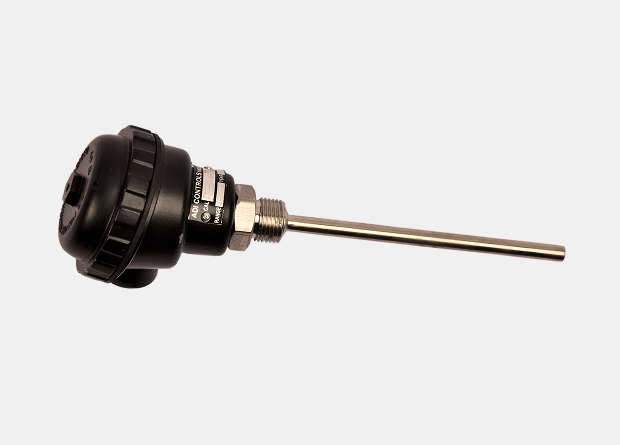
A Thermocouple with an Inconel Sheath and Aluminium Head is a premium, high-performance industrial temperature sensor assembly specifically designed for use in the most severe, high-temperature, and chemically aggressive environments.
This configuration is chosen when conditions exceed the protective capability of standard stainless steels SS316 or SS310.
1. Thermocouple Element
• Function: The internal element (often a Type K, N, or even R/S depending on the extreme temperatures involved) measures the temperature and generates a millivolt mV electrical signal.
2. Inconel Sheath
• Material: Inconel is the defining feature. It refers to a family of nickel-chromium-based superalloys (common grades include Inconel 600, 601, or 625).
• Key Advantage (Extreme Conditions): The high nickel content provides exceptional properties far beyond stainless steels:
• Superior High-Temperature Strength: Inconel maintains its mechanical integrity and resists deformation (creep) at temperatures up to 1200°C making it ideal for the hottest applications.
• Outstanding Oxidation and Carburization Resistance: It is highly resistant to corrosive attacks from hot, aggressive gases (like flue gases, exhaust gas, or petrochemical vapours) and scaling, which rapidly degrades SS310
• Chemical Corrosion Resistance: Specific Inconel grades (like 625) offer excellent resistance to various acids and reducing environments.
• Applications: Essential for use in aerospace, petroleum refining, chemical processing, nuclear reactors, and extremely hot furnace zones where temperature and chemical attack combine.
3. Aluminium Head
• Design and Function: This is the terminal head located at the cool end of the sensor.
• Purpose: It functions as a robust, sealed enclosure to protect the internal terminal block and the cold junction from dust, moisture, and mechanical impact.
• Material: Aluminium is used because it is lightweight, corrosion-resistant, and dissipates any residual heat effectively, ensuring the connection point remains stable and protected.
Product Type
Single Point Aluminium Load Cell
Usage
Table top scales, Counting and postal scales, Check weighers.
Material
Aluminium
Output
Analog Sensor
Theory
Resistance Sensor
Compensated Temperature
10 To 60 Celsius (oC)
Rated capacity (NM)
5, 10
Excitation Voltage
10 V DC – Maximum 15 V DC
Full Scale Output
2.0 mV / V
Non – Linearity
<± 0. 1 % FSO (Full scale Output)
Hysteresis
<± 0.1% FSO
Non-Repeatability
<± 0.1 % FS0
Creep error (30 minutes)
<± 0.3% FSO
Zero Output
± 1.0 % FSO
Input Resistance
392 ± 10 Ohms
Output Resistance
392 ± 10 Ohms
Insulation Resistance
>1000 Mega Ohms
Safe Overload
150 % of Rated Capacity
Ultimate Overload
250 % of Rated Capacity
Temperature
Compensated Range
10 to 60°C
Temperature Effect at Full Load
<0.05 % FSO/° C
Temperature Effect on
Zero
<0.05 % FSO/° C
Environment Protection
IP 65
Finish & Construction
Stain Less Steel 17-4 PH
Rotational Angular Deflection
< 0.2 at FSO
A temperature sensor is a device that gathers information about the thermal energy (heat) of a medium and converts that information into a readable electrical signal. Essentially, it measures heat and outputs a corresponding signal (voltage, current, or resistance) that can be interpreted by a control system or thermometer.
The three most widely used types of temperature sensors are:
The temperature reading needs to be converted into an electrical signal (like a voltage or current) so it can be:
Temperature sensing is foundational to industrial control and everyday technology:
WhatsApp us