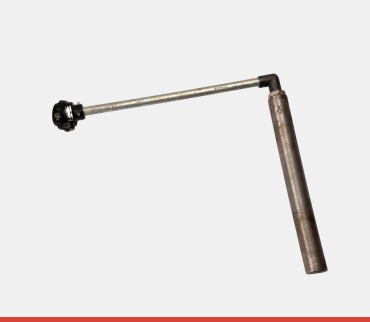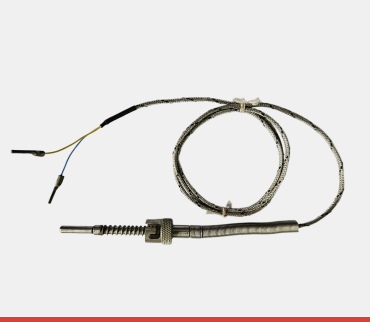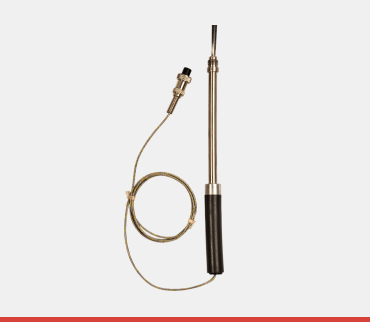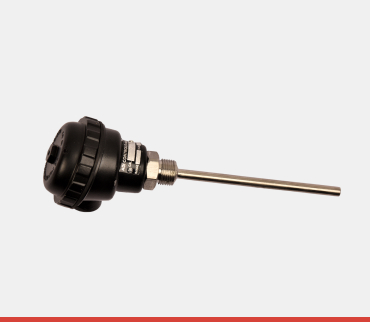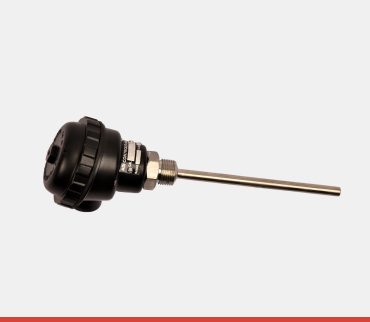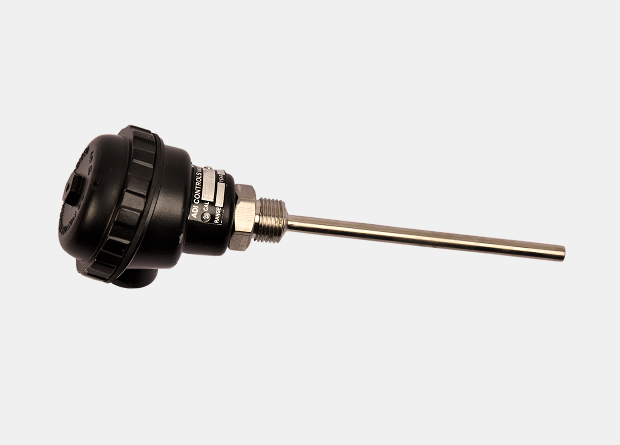
A Thermocouple with a SS310 Sheath and Aluminium Head is a specialized, high-temperature industrial sensor assembly chosen primarily for its exceptional resistance to high-temperature oxidation and scaling.
This assembly is specified for applications where temperatures regularly exceed the practical limits of more common stainless-steel grades like SS304 and SS316.
1. Thermocouple Element
• Function: The internal element (which could be Type K, N, R, or S, depending on the required temperature range) measures the heat and converts it into a minute electrical signal mV.
2. SS310 Sheath
• Material: Stainless Steel Grade 310 (SS310). This is a high-chromium and high-nickel austenitic stainless steel.
• Key Advantage (High Temperature): The significantly higher chromium content (approx. 24-26%) and nickel content make SS310 the core feature of this assembly. This composition provides:
• Excellent Oxidation Resistance: It forms a stable, protective oxide layer even in continuously high temperatures 1150°C, preventing the sheath from rapidly scaling, flaking, or degrading.
• Creep Resistance: It maintains its mechanical strength and resists deformation (creep) better than lower-grade stainless steels at elevated temperatures.
• Applications: It is essential for use in furnaces, kilns, heat treatment ovens, fluidized beds, and high-temperature exhaust systems where extreme heat and oxidizing environments would quickly destroy SS304 or SS316.
3. Aluminium Head
• Design and Function: This is the robust, protective enclosure located at the cool end of the sensor.
•Material: Aluminium is lightweight, corrosion-resistant, and dissipates heat effectively. Since the head is positioned away from the direct high heat, aluminium is suitable for protecting the sensitive electronics and connections.
Product Type
Single Point Aluminium Load Cell
Usage
Table top scales, Counting and postal scales, Check weighers.
Material
Aluminium
Output
Analog Sensor
Theory
Resistance Sensor
Compensated Temperature
10 To 60 Celsius (oC)
Rated capacity (NM)
5, 10
Excitation Voltage
10 V DC – Maximum 15 V DC
Full Scale Output
2.0 mV / V
Non – Linearity
<± 0. 1 % FSO (Full scale Output)
Hysteresis
<± 0.1% FSO
Non-Repeatability
<± 0.1 % FS0
Creep error (30 minutes)
<± 0.3% FSO
Zero Output
± 1.0 % FSO
Input Resistance
392 ± 10 Ohms
Output Resistance
392 ± 10 Ohms
Insulation Resistance
>1000 Mega Ohms
Safe Overload
150 % of Rated Capacity
Ultimate Overload
250 % of Rated Capacity
Temperature
Compensated Range
10 to 60°C
Temperature Effect at Full Load
<0.05 % FSO/° C
Temperature Effect on
Zero
<0.05 % FSO/° C
Environment Protection
IP 65
Finish & Construction
Stain Less Steel 17-4 PH
Rotational Angular Deflection
< 0.2 at FSO
A temperature sensor is a device that gathers information about the thermal energy (heat) of a medium and converts that information into a readable electrical signal. Essentially, it measures heat and outputs a corresponding signal (voltage, current, or resistance) that can be interpreted by a control system or thermometer.
The three most widely used types of temperature sensors are:
The temperature reading needs to be converted into an electrical signal (like a voltage or current) so it can be:
Temperature sensing is foundational to industrial control and everyday technology:
WhatsApp us