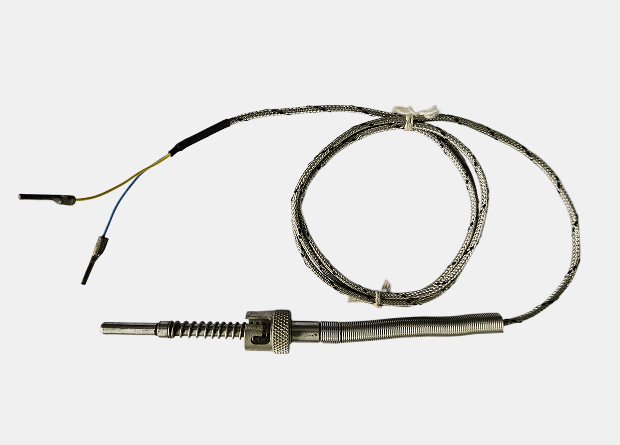
The search results suggest a slight misinterpretation of the term: “Bionet” is highly likely a misspelling of Bayonet, and FE/CO is the common material code for a Type J Thermocouple.
Therefore, the description refers to a Bayonet Type FE/CO (Type J) Thermocouple, which is a highly common sensor in the plastics and machinery industries.
🌡️ Bayonet Type FE/CO (Type J) Thermocouple
This sensor is defined by its material construction (Type J) and its unique mounting mechanism (Bayonet), which makes it a preferred choice for reliable and quick temperature monitoring in industrial processes.
1. Thermocouple Type (FE/CO)
• FE/CO stands for Iron (Fe) and Constantan (Copper-Nickel alloy – Co).
• This material pairing defines the sensor as a Type J Thermocouple.
• Characteristics:
• Range: It has a medium temperature range, typically from 0°C up to about 750°C (though often limited to around 400°C in many applications).
• Application: It is widely used in general-purpose industrial applications due to its lower cost and higher sensitivity compared to Type K in lower temperature ranges.
2. Mounting Mechanism (Bayonet Type)
• The Bayonet mechanism is a spring-loaded, quick-release mounting method.
• Description: The sensor probe is topped with a cylindrical cap that has two small radial pins. This cap fits into a corresponding adapter (usually screwed into the machine part) and is locked with a slight twist, similar to a light bulb.
Product Type
Single Point Aluminium Load Cell
Usage
Table top scales, Counting and postal scales, Check weighers.
Material
Aluminium
Output
Analog Sensor
Theory
Resistance Sensor
Compensated Temperature
10 To 60 Celsius (oC)
Rated capacity (NM)
5, 10
Excitation Voltage
10 V DC – Maximum 15 V DC
Full Scale Output
2.0 mV / V
Non – Linearity
<± 0. 1 % FSO (Full scale Output)
Hysteresis
<± 0.1% FSO
Non-Repeatability
<± 0.1 % FS0
Creep error (30 minutes)
<± 0.3% FSO
Zero Output
± 1.0 % FSO
Input Resistance
392 ± 10 Ohms
Output Resistance
392 ± 10 Ohms
Insulation Resistance
>1000 Mega Ohms
Safe Overload
150 % of Rated Capacity
Ultimate Overload
250 % of Rated Capacity
Temperature
Compensated Range
10 to 60°C
Temperature Effect at Full Load
<0.05 % FSO/° C
Temperature Effect on
Zero
<0.05 % FSO/° C
Environment Protection
IP 65
Finish & Construction
Stain Less Steel 17-4 PH
Rotational Angular Deflection
< 0.2 at FSO
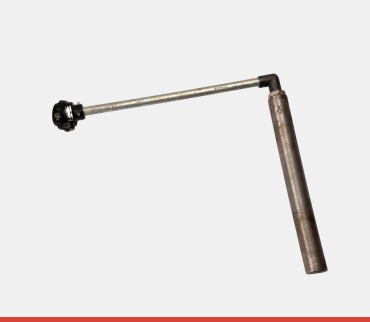
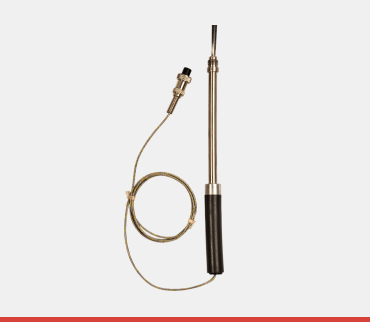
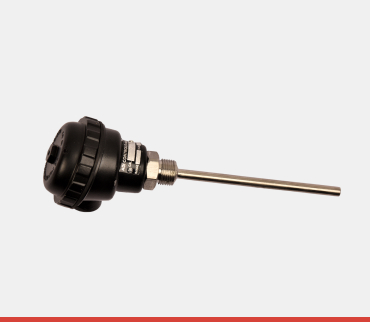
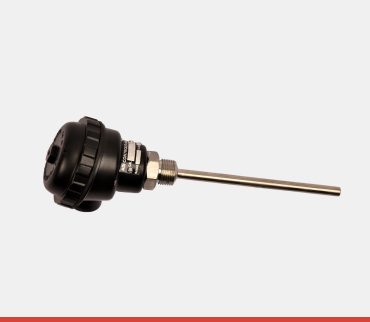
A temperature sensor is a device that gathers information about the thermal energy (heat) of a medium and converts that information into a readable electrical signal. Essentially, it measures heat and outputs a corresponding signal (voltage, current, or resistance) that can be interpreted by a control system or thermometer.
The three most widely used types of temperature sensors are:
The temperature reading needs to be converted into an electrical signal (like a voltage or current) so it can be:
Temperature sensing is foundational to industrial control and everyday technology:
WhatsApp us