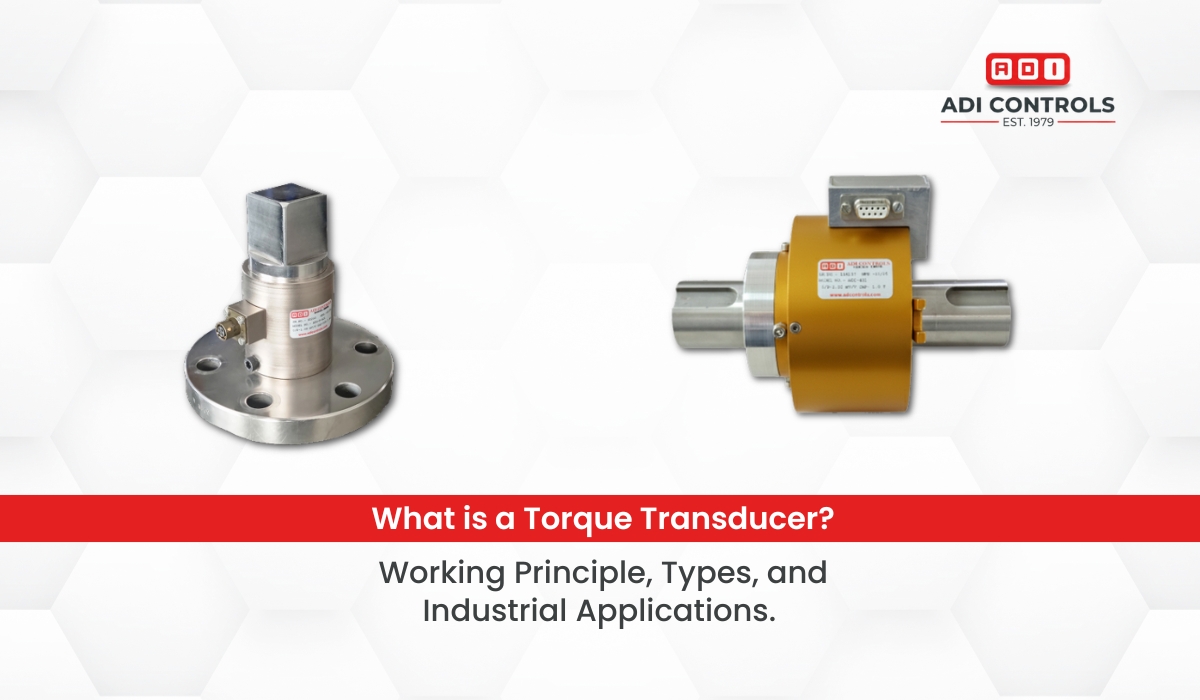
Accurate torque measurement is critical in industries where performance, safety, and product quality depend on precise control of rotational force. From validating motor efficiency to ensuring the integrity of mechanical assemblies, reliable torque data plays a vital role in modern engineering and manufacturing. At the heart of this process lies a highly specialized device known as a torque transducer.
This blog explains what a torque transducer is, how it works, the different types available, and its importance in industrial applications.
Torque is the rotational force that causes an object to turn around an axis and is typically expressed in Newton-meters (Nm). It is a fundamental parameter in systems involving motors, turbines, gearboxes, and mechanical assemblies.
Accurate torque measurement enables engineers to evaluate equipment performance, detect mechanical inefficiencies, and maintain consistent product quality. By converting torsional force into measurable electrical signals, torque transducers provide essential data for monitoring, control, and optimization in industrial systems.
A torque transducer is a precision instrument designed to measure the twisting force applied to a rotating or stationary shaft. It converts mechanical torque into an electrical output signal that can be displayed, recorded, or integrated into control and automation systems.
Widely used across industries such as automotive, aerospace, power generation, and manufacturing, torque transducers support performance validation, equipment protection, and process optimization. For organizations seeking reliable torque transducer India solutions, selecting a high-quality and durable system is essential for ensuring long-term accuracy and operational stability.
The working principle of a torque transducer is based on the strain gauge method, which measures torsional deformation in a shaft.
When torque is applied, the shaft experiences a slight angular twist. Although this deformation is extremely small, it can be accurately measured using strain gauges bonded to the shaft surface.
The process works as follows:
High-quality torque transducers are engineered to maintain predictable elastic behavior, ensuring precise and repeatable torque measurement under varying load conditions.
Different applications require different torque measurement solutions. The most common types include static torque transducers and dynamic torque transducers, each designed for specific operational requirements.
A static torque transducer is used to measure torque applied to a stationary or slow-moving shaft. It is commonly used in calibration laboratories, valve testing, and quality control environments, where torque is applied and held to ensure accurate measurement.
These transducers are ideal for applications requiring high precision and repeatability without continuous rotation. They are widely used for torque tool calibration, assembly verification, and testing applications where consistent and stable readings are critical.
A dynamic torque transducer is designed to measure torque in rotating systems where torque varies continuously during operation. These transducers provide real-time torque measurement while the shaft is in motion, making them suitable for high-speed and performance-driven applications.
Dynamic torque transducers are commonly used in motor testing, gearbox evaluation, automotive R&D, turbine performance monitoring, and industrial automation systems. Their ability to capture fluctuating torque values ensures accurate performance analysis, process optimization, and preventive maintenance in dynamic operating environments.
Although the terms “torque transducer” and “torque sensor” are frequently used interchangeably, there is a technical distinction:
In practical industrial applications, both terms generally refer to devices used to measure torque.
Torque transducers are essential across multiple industrial sectors where precision and performance are critical.
These applications highlight the importance of reliable torque measurement systems in maintaining operational excellence.
The accuracy and reliability of torque measurement depend on several critical factors:
Poorly designed torque transducers may introduce hysteresis errors, signal drift, and measurement inconsistencies. Selecting high-quality torque transducer solutions ensures dependable performance even in harsh industrial environments.
ADI Controls offers advanced torque transducer systems engineered for precision, durability, and seamless integration into modern industrial processes.
Implementing high-performance torque measurement systems provides several advantages:
These benefits make torque transducers indispensable for industries striving for precision-driven manufacturing and quality assurance.
A torque transducer is a vital instrument for measuring rotational force in industrial applications. By converting mechanical torque into precise electrical signals, it supports quality control, performance validation, and equipment protection across a wide range of industries.
Whether using a static torque transducer for calibration or an inline torque transducer for dynamic monitoring, accurate torque measurement is essential for ensuring safe and efficient operations.
For organizations seeking reliable torque transducer India solutions, ADI Controls provides advanced instrumentation systems designed for accuracy, durability, and long-term performance. Investing in high-quality torque measurement technology ensures improved productivity, operational safety, and consistent industrial excellence.
A torque transducer is a precision device used to measure the rotational force applied to a shaft. It converts mechanical torque into an electrical signal that can be monitored, recorded, or integrated into industrial control systems for accurate torque measurement.
A torque transducer operates on the strain-gauge principle. When torque is applied to a shaft, it causes a slight deformation. Strain gauges bonded to the shaft detect this deformation and convert it into an electrical signal proportional to the applied torque.
Torque transducers are widely used in automotive testing, aerospace engineering, power generation, manufacturing, and research laboratories. They help ensure equipment reliability, product quality, and operational safety.
WhatsApp us