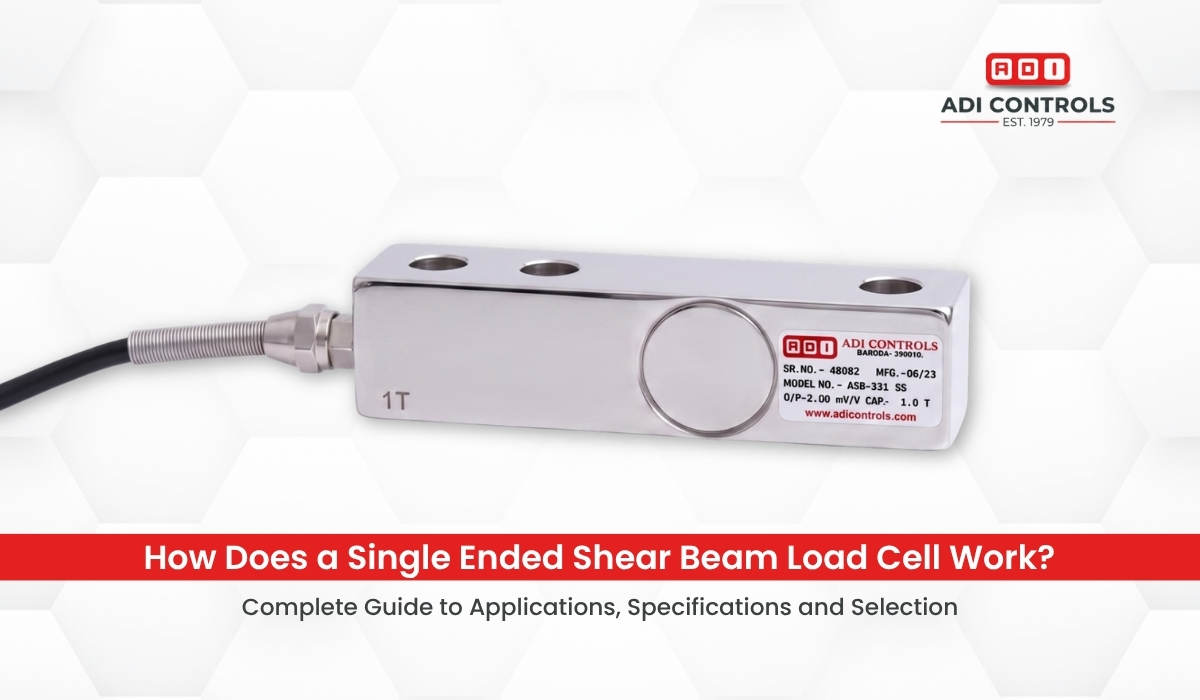
If you have ever looked inside a platform scale or a small hopper, chances are you have seen a single ended shear beam load cell doing the heavy lifting. It’s one of the most widely used sensor designs in industrial weighing: compact, easy to mount, and accurate enough for most standard jobs.
In this guide, we will walk through how this load cell works, where it fits best, and what to check before choosing one.
Picture a metal beam that is fixed solidly at one end while the other end carries the load. That’s what a single ended shear beam load cell looks like. As weight is applied, the beam flexes very slightly, and sensors inside detect that tiny change.
This single-point mounting style makes it a popular choice wherever space is limited but accuracy still matters. ADI Controls’ ASB-331 is a good real-world example of this design.
Here is the easy version, without the engineering jargon. When a load presses down on the beam, it bends just slightly, in a way that is invisible to the eye. Sensors bonded to the beam pick up on that tiny change and turn it into an electrical signal.
That signal is then sent to an amplifier or indicator, which translates it into a weight reading you can actually use. Because the beam design handles this so precisely, you’ll find it in a wide range of industrial setups.
Buyers often get stuck choosing between these two, so here is the short version.
A single ended shear beam load cell is fixed at one end, which makes it ideal for smaller platforms and lighter to medium loads. A double ended shear beam load cell, on the other hand, is supported at both ends, which suits longer spans and higher capacities, such as larger tanks or industrial platforms.
If your application is compact, a single ended design usually does the job. For bigger loads or longer platforms, go with the double ended version instead.
Because of its accuracy and compact footprint, this load cell type shows up across many industries, including:
• Platform and bench scales
• Packaging and bag filling machines
• Conveyor belt scales
If your setup involves any of these, there is a good chance this load cell design would be a strong fit.
There are a few clear reasons this design remains so popular. It delivers strong accuracy for small to medium capacities, resists errors from slightly off-center loading, and mounts easily at a single point. On top of that, it tends to be more cost-effective than larger, dual-mount alternatives.
For many standard weighing applications, these benefits make it a practical, no-fuss choice.
Before you buy, run through this quick checklist:
• Capacity needed for your heaviest expected load, plus some safety margin
• Environment, especially if it will face washdowns, dust, or moisture
• Material, since stainless steel usually holds up better in harsh conditions
• Calibration support from the manufacturer, so it is set up correctly from day one
Getting these details right upfront saves a lot of trouble down the line.
A single ended shear beam load cell strikes a solid balance between accuracy and cost, without adding mounting complexity. If you are planning a new weighing setup or replacing an existing sensor, explore ADI Controls’ load cell range or get in touch for guidance on the right fit
A single point load cell reads weight accurately even when the load is off-center, while a shear beam load cell is generally better suited for slightly higher capacities and platform-style weighing.
Yes, as long as it has an appropriate IP rating or sealing for outdoor and washdown conditions. It is worth confirming this with the manufacturer for your specific environment.
WhatsApp us