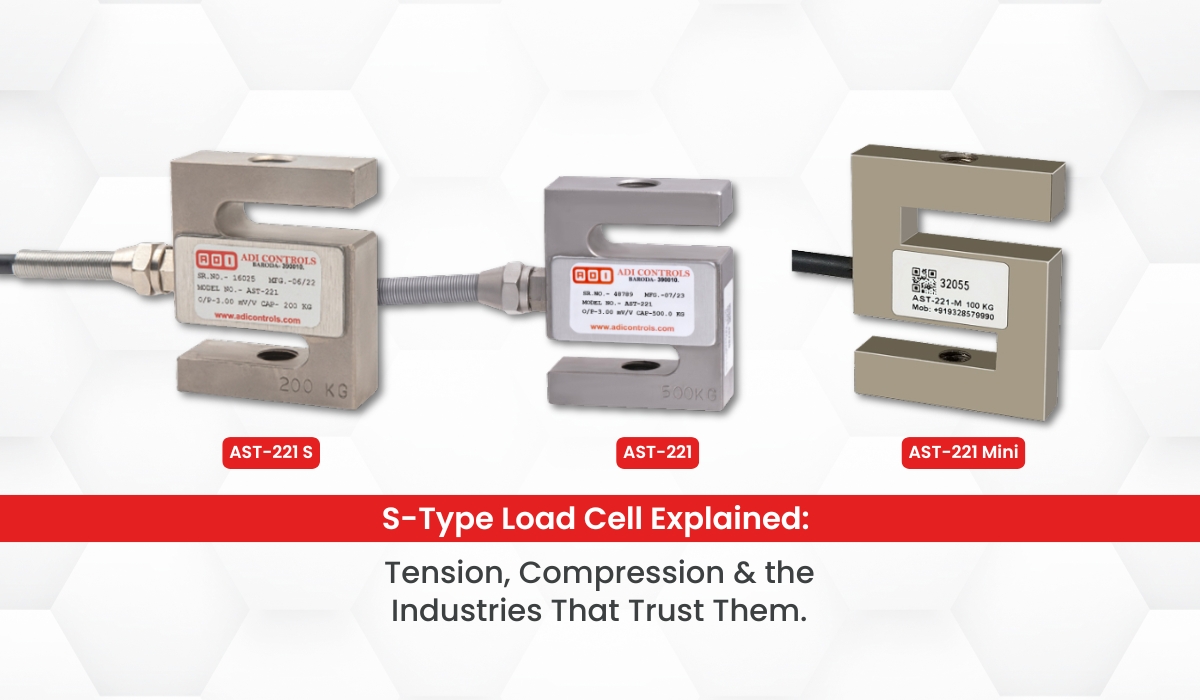
If you have ever wondered how a grain silo knows exactly how much wheat it holds, or how a crane operator knows the safe load limit in real time, the answer often comes down to one compact device – a load cell.
Among the many types available, the S-type load cell has earned a strong reputation across industries. Its design is simple, its performance is dependable, and its range of applications is surprisingly wide.
The name says it all. An S-type load cell has an S-shaped body, usually machined from stainless steel or alloy steel. This shape is not just aesthetic. It allows the sensor to handle forces from two directions -tension (pulling) and compression (pushing) – without needing separate devices for each.
At its core, the load cell uses strain gauges bonded to the body. When force is applied, the metal flexes slightly. The strain gauges detect that deformation and convert it into an electrical signal. That signal is then processed to give an accurate force or weight reading.
This is how load cells work at a fundamental level. The S-type design simply makes this process effective in both directions.
Many industries need to measure pulling forces, not just weight. Crane hooks, cable tension systems, and overhead lifting rigs all require tension measurement. An S-type load cell handles this naturally because of how its mounting points are designed.
Compression measurement is equally important. In hopper weighing, tank filling, or industrial floor scales, downward force needs to be measured with precision. The same S-type sensor handles this without modification.
This dual capability is one of the main reasons engineers and plant managers prefer this design over more specialized alternatives.
Traditional load cells output a small millivolt signal. This worked well for decades. But today, most setups use a digital load cell or connect the sensor to a digital signal conditioner.
Digital conversion brings several advantages. Noise interference is reduced. Signal transmission over longer distances becomes more reliable. And data logging becomes far easier when the output is already in digital format.
A load cell controller sits at the center of this process. It receives the signal, applies calibration settings, and displays the result as a readable value. In automated systems, the controller also triggers actions such as stopping a conveyor belt when a target weight is reached or sending an alert when tension exceeds a safe limit.
Standard S-type units cover most applications. But sometimes a project demands something specific – an unusual capacity range, a particular connector type, a non-standard housing material, or resistance to chemicals. In these cases, a custom load cell is the right path.
Custom designs follow the same core principles. The S-shaped body, strain gauge placement, and signal output remain consistent. What changes is the specification sheet. Engineers work with manufacturers to define the exact requirements, and the result is a sensor built precisely for that environment.
Getting the best results from an S-type load cell depends on more than just the sensor itself. Proper mounting matters. The load should be applied along the central axis. Misalignment introduces measurement error.
The load cell controller should be matched to the sensor output range. Calibration should be done at installation and rechecked periodically. In harsh environments, cable protection and moisture sealing are important considerations.
When these details are handled correctly, an S-type load cell can deliver years of accurate, consistent performance with minimal maintenance.
From agriculture to industrial automation, the right load cell makes all the difference.
Find your ideal solution with ADI Controls and take the next step toward precision.
It is used to measure both pulling and pushing forces in applications like hanging scales, tanks, and industrial systems.
It converts force into an electrical signal using strain gauges and displays the weight through a controller.
Yes, it is designed specifically to handle both types of forces.
They are used in agriculture, manufacturing, packaging, and lifting systems.
It is a system that converts load cell signals into digital data for accurate and easy reading
WhatsApp us