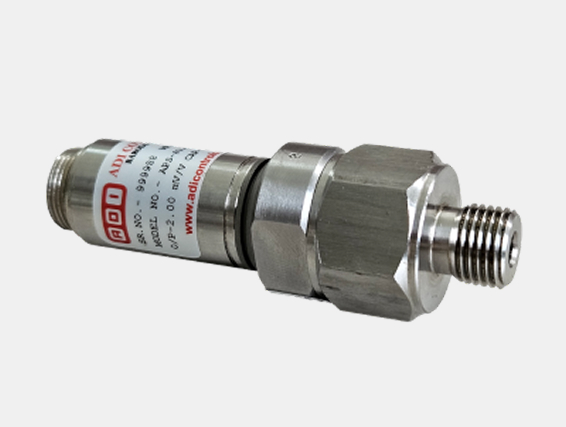
APT-411

Pressure Transducer

APT-411

Pressure Transducer

ADI APT-411 pressure transmitter, often also called a pressure transducer, is a mechanical device used to measure the expansive force of a liquid or gaseous sample in industrial settings. It’s a vital element in many industrial applications, converting a pressure measurement into an analog electrical signal. The core of the device is a pressure-sensitive surface (like a diaphragm made of steel or silicon). This element deforms or deflects when pressure is applied.

Product Type

Single Point Aluminium Load Cell

Usage

Table top scales, Counting and postal scales, Check weighers.

Material

Aluminium

Output

 Analog Sensor

Theory

Resistance Sensor

Compensated Temperature

10 To 60 Celsius (oC)

Rated capacity (NM)

5, 10

Excitation Voltage

10 V DC – Maximum 15 V DC

Full Scale Output

2.0 mV / V

Non – Linearity

<± 0. 1 % FSO (Full scale Output)

Hysteresis

<± 0.1% FSO

Non-Repeatability

<± 0.1 % FS0

Creep error (30 minutes)

<± 0.3% FSO

Zero Output

± 1.0 % FSO

Input Resistance

392 ± 10 Ohms

Output Resistance

392 ± 10 Ohms

Insulation Resistance

>1000 Mega Ohms

Safe Overload

150 % of Rated Capacity

Ultimate Overload

250 % of Rated Capacity

Temperature
Compensated Range

10 to 60°C

Temperature Effect at Full Load

<0.05 % FSO/° C

Temperature Effect on
Zero

<0.05 % FSO/° C

Environment Protection

IP 65

Finish & Construction

Stain Less Steel 17-4 PH

Rotational Angular Deflection

< 0.2 at FSO

Industries

Batching & Mixing Plant
UTM Machines
Tablet Compression Testing
Structural Load Testing
Industrial Presses
FAQs

frequently asked questions

01. What is a pressure transducer (or sensor), and what does it measure?

A pressure transducer, often simply called a pressure sensor, is a device that converts an applied pressure (force per unit area) into a measurable electrical signal.

It measures various forms of pressure, including:

  • > Gauge Pressure: The pressure relative to the surrounding atmospheric pressure.
  • > Absolute Pressure: The pressure relative to a perfect vacuum.
  • > Differential Pressure: The difference between two separate pressure points.

The output signal is proportional to the input pressure, often measured in units like PSI (pounds per square inch), KPI (kilopascals).

02. How does a typical pressure transducer work (Piezoresistive Technology)?

Most modern pressure transducers use piezoresistive technology:

  1. Sensing Element: A flexible diaphragm (often made of silicon or stainless steel) is exposed to the pressure.
  2. Piezo resistors: Tiny, specially designed resistors are embedded or bonded to the diaphragm.
  3. Resistance Change: When pressure is applied, the diaphragm slightly deforms. This deformation causes the physical dimensions of the resistors to change, which alters their electrical resistance (the piezoresistive effect).
  4. Signal Conversion: These resistors are connected in a Wheatstone bridge circuit, which converts the resistance change into a stable, amplified voltage or current signal 4-20mA or 0-10VDC for monitoring.
03. What are the most common output signal types for a pressure transducer?

Pressure transducers are designed to provide a signal that is easily integrated into industrial control systems (PLCs, data loggers). The two most common output types are:

  • > Current Output (4-20mA): This is the most robust and preferred industrial standard. It’s excellent for long cable runs and is less susceptible to electrical noise. The mA signal represents the zero pressure reading, and the mA represents the full-scale pressure reading.
  • > Voltage Output (0-10VDC): Often used in shorter distance applications or where low power consumption is necessary. While easier to interface with some low-cost electronics, it is more susceptible to voltage drops over long cables.
04. What are some common applications for pressure transducers?

Pressure transducers are fundamental sensors used across almost every industry:

  • > HVAC/Building Automation: Monitoring air duct pressure, filter blockage, and water pressure in pipes.
  • > Industrial Hydraulics & Pneumatics: Measuring fluid pressure in hydraulic presses, pumps, and pneumatic lines for safety and control.
  • > Automotive: Monitoring engine oil pressure, tire pressure (TPMS), and fuel rail pressure.
  • > Medical/Pharmaceutical: Monitoring fluid flow in manufacturing processes or within medical devices.
  • > UTM machines, Transit Mixer, Concrete Mixer.
05. What is the difference between Gauge, Absolute, and Differential pressure transducers?

The difference lies in the reference point used for the measurement:

  • > Gauge Pressure (PSIG): Measures pressure relative to the current ambient atmospheric pressure. It is typically vented to the atmosphere and is used for most industrial applications where pressure above the surrounding air is important (e.g., tire pressure).
  • > Absolute Pressure (PSIA): Measures pressure relative to a perfect vacuum (zero pressure). The reference side of the sensor is sealed under a vacuum. This is used where atmospheric pressure changes must be ignored (e.g., measuring vapor pressure or altitude).