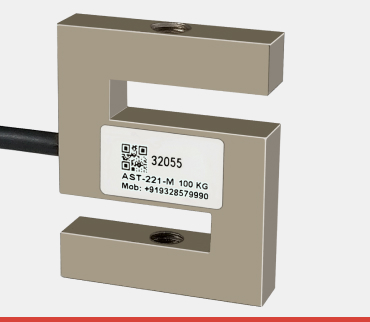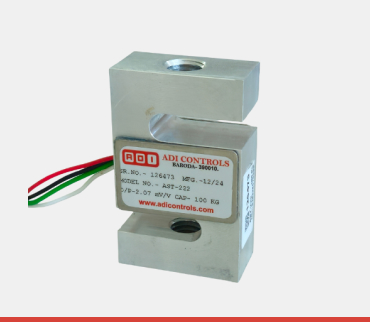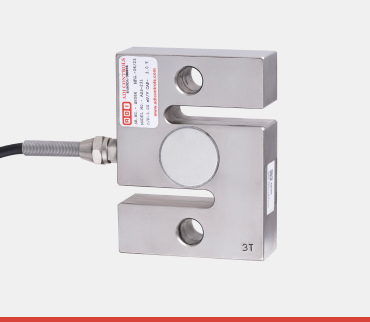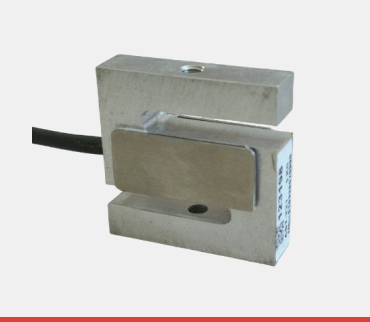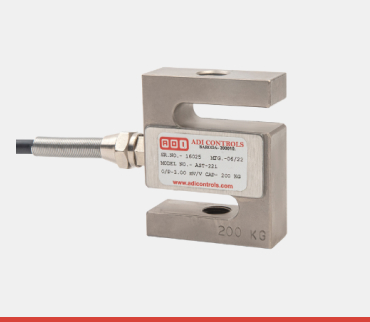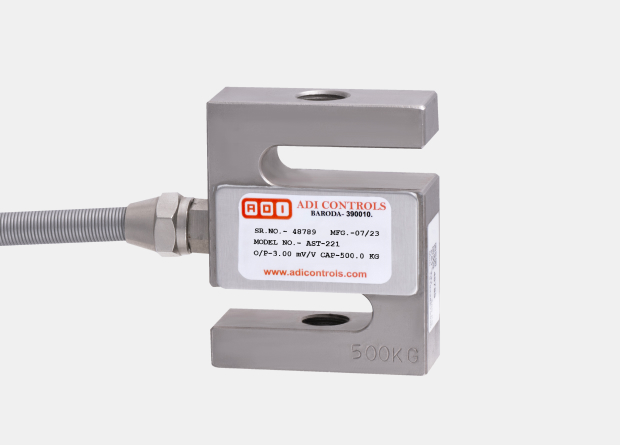
ADI CONTROLS Model AST-221 is a S-type load cell (also known as an S-beam or S-shaped load cell) is a tension and compression force transducer characterized by its distinct S-shape. It’s highly versatile, designed to measure both tensile force (pulling) and compressive force (pushing). This dual-capability is one of its primary advantages. When a force is applied (either tension or compression), the S-shaped body deforms slightly. Strain gauges bonded to the internal webs of the S-shape measure this deformation and convert it into a proportional electrical signal. It is also known as 20210
Product Type
Single Point Aluminium Load Cell
Usage
Table top scales, Counting and postal scales, Check weighers.
Material
Aluminium
Output
Analog Sensor
Theory
Resistance Sensor
Compensated Temperature
10 To 60 Celsius (oC)
Rated capacity (Kgf)
20, 50, 100, 200, 250, 300, 500, 750
1, 1.5, 2, 2.5, 3, 5,7.5,10
Excitation Voltage
10VDC-Maximum 15 VDC
Rated Output
3.0 mV/V
Non – Linearity
< ± 0.025 % FSO (Full scale Output)
Hysteresis
< ± 0.02 % FSO
Non-Repeatability
< ± 0.01 % FSO
Creep error (30 minutes)
< ± 0.03 % FSO
Zero Load Output
± 1.0 % FSO
Input Resistance
390 ± 15 Ohms
Output Resistance
350 ± 5 Ohms
Insulation Resistance
>1000 Mega Ohms
Safe Overload
150 % of Rated Capacity
Ultimate Overload
250 % of Rated Capacity
Temperature
Compensated Range
0 to 60° C
Temperature Effect on
Output
<0.0015 % FSO/° C
Temperature Effect on
Zero
< 0.002 % FSO/° C
Side Load Allowed
50 % of Rated Capacity
Deflection
< 0.5 mm at FSO
Finish & Construction
Electroless Nickel Plated Tool Steel
Environment Protection
IP 67
Tightening Torque
Refer Table
An S-Type load cell, often called an S-Beam load cell, is a force transducer named for its distinct “S” shape. Its unique mechanical design allows it to accurately measure force in two directions:
The main advantage is its versatility and compact size, which makes it ideal for inline force measurement where space is limited and both pushing and pulling forces need to be monitored.
What are the most common applications for S-Type load cells?
S-Type load cells are preferred in systems requiring high accuracy for both tension and compression measurements.
Accurate installation is critical, as S-Type cells are sensitive to off-axis (side) loading.
The rated capacity should always be higher than the maximum expected force to ensure safety and prevent overload damage.
Always account for the weight of any attached rigging (like eyebolts or cables) when calculating the total maximum load.
S-Type load cells are commonly manufactured from materials suitable for industrial use:
Material | Typical Application Environment | IP Rating |
Alloy Steel | General industrial use, high strength, cost-effective. | Usually IP65 (Dust-tight, protected against water jets). |
Stainless Steel | Harsh, corrosive, or wet environments (e.g., food & beverage, chemical processing). | Usually IP67 (Waterproof immersion up to 1m) or IP68 (Continuous submersion). |
The IP (Ingress Protection) rating is key. For most indoor, dry environments, IP65 is sufficient. If the load cell will be exposed to regular washdowns, high humidity, or outdoor weather, an IP67 or IP68 rating is essential for longevity.
WhatsApp us