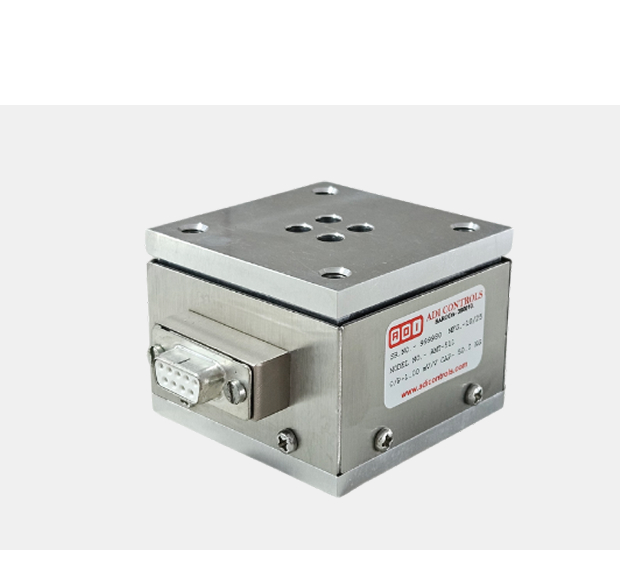
ADI AMT-511 multi-axis load cell (also known as a multi-component force sensor or 6-axis load cell) is a specialized transducer capable of measuring forces and moments (torques) simultaneously along or around multiple independent axes. Unlike standard single-axis load cells, these sensors can measure up to six components of force. Forces along the X, Y, and Z axes can be measured. The sensor’s body is intricately machined, often featuring a cruciform, spoke, or web design, to decouple the different load components. Since the application of force on one axis often induces a small signal on others (known as crosstalk), a complex mathematical calibration matrix (or decoupling matrix) is essential to separate the raw signals and provide accurate, independent measurements for all six components.
Product Type
Single Point Aluminium Load Cell
Usage
Table top scales, Counting and postal scales, Check weighers.
Material
Aluminium
Output
Analog Sensor
Theory
Resistance Sensor
Compensated Temperature
10 To 60 Celsius (oC)
Rated capacity (Kgf)
20, 30
Excitation Voltage
10 VDC-Maximum 15 VDC
Rated Output
1.2 mV/V in X & Y axis. 1.4 mV/V for Z axis
Non – Linearity
<±0.5 % FSO (Full scale Output)
Hysteresis
<± 0.5 % FS0
Non-Repeatability
<± 0.2 % FS0
Creep error (30 minutes)
<+ 0.05 % FS0
Zero Output
± 1.0 % FSO
Bridge Resistance
350 ± 10 Ohms
Output Resistance
700 +/- 5 Ohms
Insulation Resistance
> 2000 Mega Ohms
Temperature
Compensated Range
10° to 60° C
Temperature Effect at Full Load
< 0.05 % FSO/° C
Temperature Effect at Zero Load
< 0.05 % FSO/° C
Side Load Allowed
50 % of Rated Capacity
Finish & Construction
Aluminium
Environment Protection
IP 65
A Multi-Axis Load Cell is an advanced force sensor designed to measure multiple independent force and/or torque components simultaneously.
These high-precision sensors are used in complex, high-tech environments where a holistic view of force and torque is necessary.
Crosstalk (or cross-axis sensitivity) refers to the unavoidable, small influence that a load applied to one axis (e.g. F x) has on the measured output of another axis (e.g. F y or F z).
Selecting the capacity is more complex than for a single-axis cell, as multiple forces must be considered simultaneously.
Due to the complexity of the output, Multi-Axis Load Cells require specialized hardware and software:
WhatsApp us