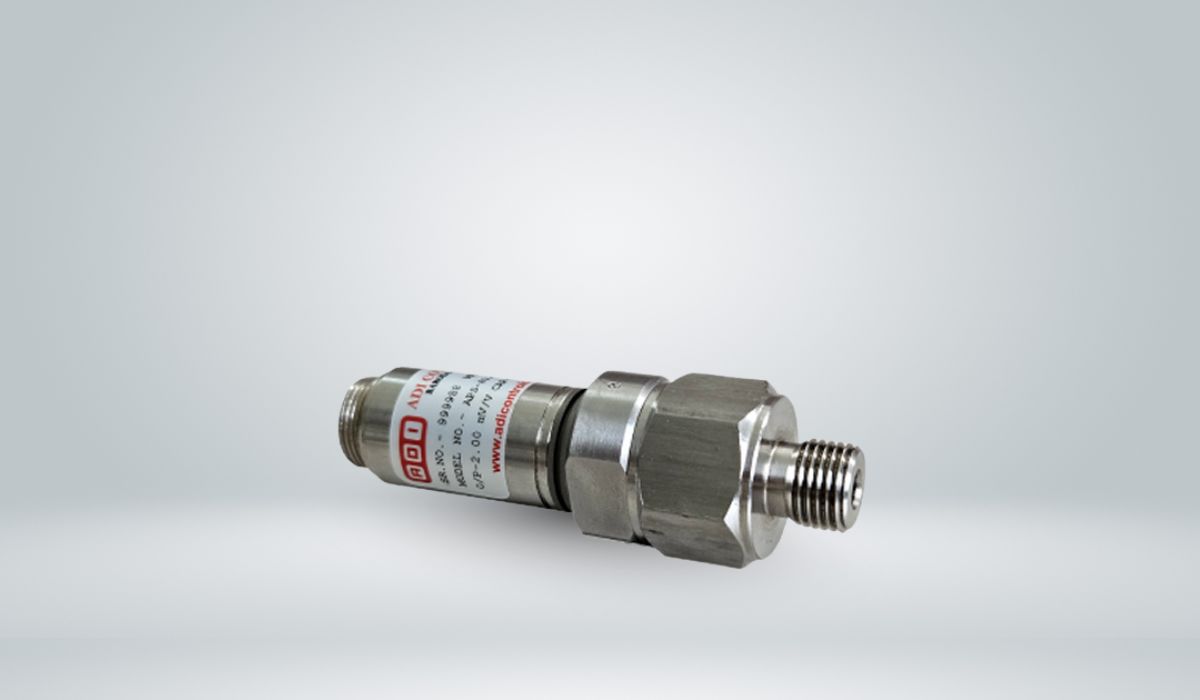
In virtually every industrial process—from brewing coffee to refining petroleum—pressure is a fundamental variable that must be accurately measured and controlled. If pressure is too high, equipment can fail; if it’s too low, the process might stop or become inefficient. The key device responsible for this critical measurement is the Pressure Transmitter.
A pressure transmitter is an instrument that measures pressure and converts this measurement into a standardized, usable electrical signal. While a simple pressure gauge just displays the reading, the transmitter’s job is to translate the physical force into an electronic language that can be understood by control systems like PLCs (Programmable Logic Controllers) or DCS (Distributed Control Systems).
The standard output signal is typically an analog current signal, most commonly 4-20 mA (milliamps), or a digital protocol like HART, Fieldbus, or Profibus.
Most modern pressure transmitters rely on a core component called the sensor element, which converts pressure into a displacement or force. The most common type is the capacitive sensor or the piezoresistive sensor.
The process starts with a thin, flexible diaphragm that is exposed to the fluid or gas whose pressure needs to be measured.
2. The Transduction Element
The deflection of the diaphragm must then be converted into an electrical signal:
3. Signal Conditioning
The small, raw electrical signal from the sensor element is processed by internal electronics (signal conditioning) to amplify, filter, and linearize it, producing the clean, industry-standard 4-20 mA or digital output.
The Three Main Pressure Measurements
Pressure transmitters are designed to measure three specific types of pressure:
| Type of Pressure | Absolute Pressure | Gauge Pressure | Differential Pressure (DP) |
|---|---|---|---|
Absolute Pressure |
Measured relative to a perfect vacuum (0 PSIA/bar a). |
Vacuum |
Altimeters, vacuum packaging, leak detection. |
Gauge Pressure |
Measured relative to the ambient atmospheric pressure (0 PSIG/bar g). |
Ambient Air |
Tire pressure, utility lines, process vessels. |
Differential Pressure (DP) |
Measures the difference between two separate pressures ($\Delta P$). |
$P_1 – P_2$ |
Flow measurement (using an orifice plate), level measurement in sealed tanks, filter monitoring. |
Pressure transmitters are the eyes and ears of control systems in countless industries:
Accurate pressure measurement is non-negotiable for both operational control and safety. The pressure transmitter remains one of the most vital, yet often unseen, instruments keeping our modern world running smoothly!
WhatsApp us