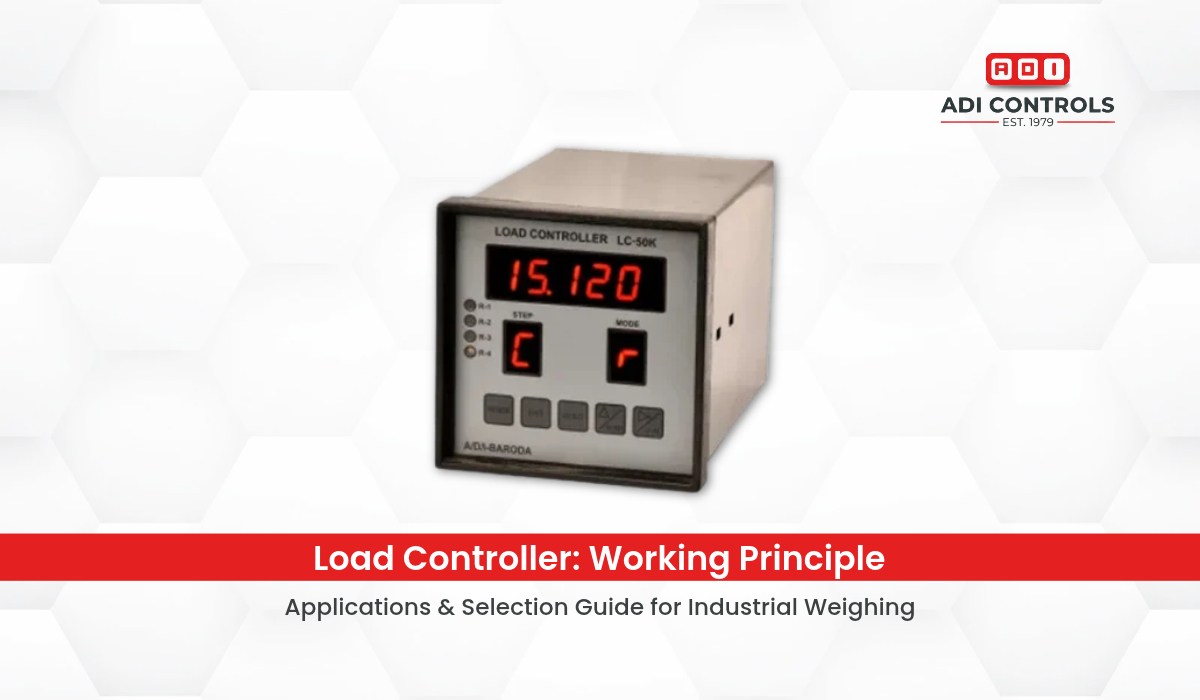
A hopper that overfills by a few kilograms wastes material every batch. A crane that lifts beyond its safe limit risks lives. Both problems start with weight data that nobody acts on in time. A load controller closes that gap. It reads the weight and triggers action.
This guide explains how a load controller works, where industries use it, and how to select the right one for industrial weighing.
A load controller is an electronic instrument that receives the signal from one or more load cells and converts it into a weight value. It shows the value on a digital display. It also switches relays or sends signals when the weight crosses a preset limit.
Some people call it a load cell controller or a weighing controller. The core idea stays the same. It turns raw sensor data into a decision.
Signal Conditioning and Conversion
The load controller supplies excitation voltage to the load cells. Under load, the cells return a very small millivolt signal. The controller amplifies this signal and filters electrical noise. An analog-to-digital converter then changes it into digital counts. Calibration maps those counts to kilograms or tonnes.
Set Points and Relay Control
Operators enter set point values in the load controller. The device compares live weight with each set point. When weight reaches a limit, a relay closes or opens. That relay can stop a feeder, close a valve, or sound an alarm. A batching line, for example, may use one set point for coarse feed and another for fine feed.
Many models offer analog outputs such as 0 to 10 V or 4 to 20 mA. Others use RS485 with Modbus RTU. These links send weight data to a PLC, a computer, or a large remote display.
Batching and Dosing
Recipe-based plants use a load controller to add each ingredient by weight. The unit stops the feed at the set value and helps repeat batches with consistent results.
Hopper, Tank, and Silo Weighing
Load cells under vessel legs feed the controller. Operators see contents by weight, and relays prevent overfilling.
Crane and Lift Overload Protection
A load controller can trip an alarm or cut power when the lifted weight crosses the safe limit. This protects equipment and people.
Weighbridges and Platform Scales
The controller combines signals from several cells and presents one clear weight reading to the operator.
Selection starts with the process, not the product catalogue. Ask what action the weight reading must trigger.
Load Cell Count and Excitation
Count the cells in your system. Confirm that the load controller can power them and accept their combined signal. Some models accept several cells directly. Others need a summing junction box.
Accuracy, Resolution, and Update Speed
Check the indicating accuracy and the number of counts. Fast processes like filling need a quick update rate. Slow processes like tank monitoring can use heavier filtering for stability.
Relays and Outputs
Match the number of set points to your process steps. Confirm the relay ratings. Check for an analog output if a PLC needs a proportional signal.
Communication, Power, and Panel Fit
Confirm the supply voltage, the panel cutout size, and the protocol. Panel-mounted units must fit existing cabinets. Wireless options help when cabling is hard.
Buyers often pick too few relays, overlook supply voltage, or ignore noise on long cable runs. A short review of the control logic prevents these errors.
ADI Controls manufactures load controllers in Vadodara, Gujarat. The range includes the LC-50K and LC-60K load cell controllers, the LC-5010 load controller, and the LC-4500 load controller. The LC-5010 offers up to six set points and relay contacts, along with RS485 Modbus communication. A wireless load transmitter and controller is also available for sites where cabling is impractical.
Tell ADI Controls about your process, the number of load cells, and the control action you need. The team will recommend a suitable load controller and prepare a quotation. Visit adicontrols.com or contact the team today.
A load controller is an electronic instrument that reads the signal from load cells, converts it into a weight value, displays it, and switches relays at set weights. It links sensors to alarms, valves, feeders, or PLC systems.
It supplies excitation voltage to the load cells and measures the tiny millivolt signal returned. An analog-to-digital converter turns it into a calibrated weight reading. The controller compares that reading with set points and operates relay outputs.
An indicator mainly displays weight. A load controller also acts on the weight by switching relays and sending analog or digital outputs. Many modern units combine both roles, so check the relay count and communication options before buying.
It depends on the model and its excitation capacity. Several load cells are usually wired through a summing junction box, so the controller sees one combined signal. Check the datasheet for the maximum number of cells.
Choose a unit with enough set points and relays for your batch steps, stable accuracy, and fast filtering. RS485 Modbus or analog outputs help when a PLC manages the process. Share your batch size and cycle time with ADI Controls for guidance.
WhatsApp us