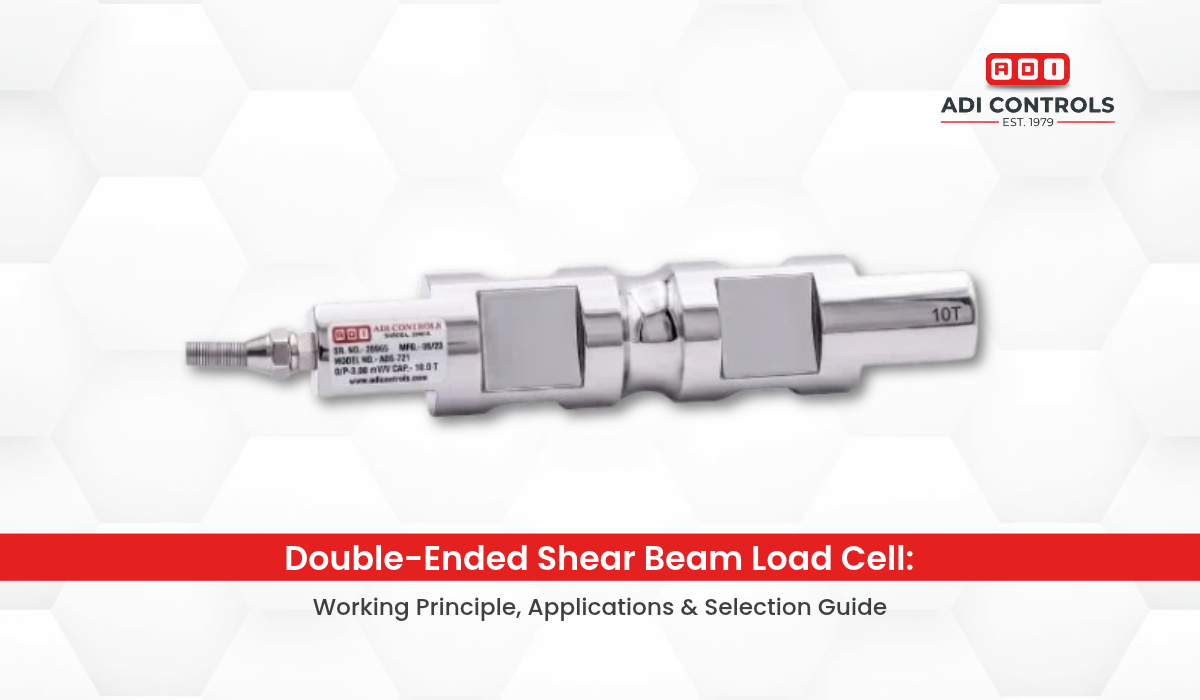
A truck weighbridge that drifts after every monsoon is a costly problem. So is a hopper that reads each shift differently. In many plants, the root cause sits in the sensing element. A double-ended shear beam load cell is built for exactly these heavy-duty jobs.
This guide explains how a double-ended shear beam load cell works, where it fits, and how to select one with confidence.
A double-ended shear beam load cell is a force sensor that measures weight through shear strain in a beam. The beam rests on supports at both ends. The load is applied at the centre.
Its rugged body suits heavy industrial weighing. Capacities typically run from a few tonnes to over one hundred tonnes.
How the Beam Senses Weight
When weight is placed on the platform, the load transfers to the centre of the beam. The two ends stay fixed on mounts. This creates shear stress inside the beam body between the load point and each support. Strain gauges are bonded at the neutral axis of the beam, set at an angle of 45 degrees. They pick up this shear strain directly.
From Strain to Electrical Signal
The gauges are wired as a Wheatstone bridge. A stable excitation voltage is applied to the bridge. The load unbalances it, and the cell returns a small output signal measured in mV/V. A load controller or indicator reads this signal and shows the weight.
Why Shear Sensing Improves Weighing Accuracy in a Double-Ended Shear Beam Load Cell
Shear strain at the neutral axis is less affected by bending forces. Small shifts in load position therefore cause smaller errors. The design also handles side forces better when it is paired with proper mounting hardware.
Truck and Industrial Weighbridges
Four to eight cells usually sit under the deck. Each cell takes a share of the vehicle weight. Sealed construction protects the strain gauges from rain, dust, and washdown.
Tank, Silo, and Hopper Weighing
Cells placed under the vessel legs measure the weight of contents without touching the product. A chemical plant, for example, can track a reactor feed by weight and avoid level sensor errors caused by foam or sticky material.
Batching and Process Lines
Cement, chemical, and food plants use these cells to repeat recipe weights batch after batch.
Capacity and Safety Margin
Add the dead load of the structure to the maximum live load. Divide the total by the number of cells. Then add a margin of 25 to 50 percent. For example, a tank weighs 4,000 kg empty and holds 12,000 kg of product. The total is 16,000 kg. Across four cells, each carries 4,000 kg. A 5-tonne cell gives a sensible margin.
Accuracy and Standards
Match the accuracy class to the application. Trade weighing needs approved classes. Process weighing can accept less strict limits. Ask for non-linearity, hysteresis, and repeatability values in the datasheet.
Environment and Protection
Check the IP rating, material finish, and temperature range. Alloy steel with nickel plating suits outdoor pits. Stainless steel suits washdown areas.
Mounting and Side Load
Use mounting assemblies designed for the cell. They allow small thermal movement and guide the load. Pipes and cables attached to tanks should be flexible, because rigid connections shift the load path.
Signal Chain
Analog cells connect through a summing junction box to a load controller or indicator. Digital cells with RS485 output suit long cable runs and noisy plants.
Undersizing for shock loads, ignoring uneven foundations, and skipping proper cable shielding cause most field problems.
ADI Controls designs and manufactures load cells and instrumentation in Vadodara, Gujarat. The range includes the ADS-741 double-ended shear beam load cell and the ADS-761 cup and ball weighbridge load cell. Matching load controllers and indicators are available for a complete weighing system. ADI Controls engineers can review your capacity, mounting arrangement, and site conditions before you order.
Share your application, capacity range, and operating environment with ADI Controls. The team will suggest a suitable double-ended shear beam load cell and prepare a quotation. Visit adicontrols.com or contact the team today.
A double-ended shear beam load cell is a force sensor supported at both ends with the load applied at the centre. Strain gauges read shear strain in the beam and convert it into an electrical signal proportional to weight.
It is widely used in truck weighbridges, tank and hopper weighing, silo systems, platform scales, and batching lines. These jobs involve heavy loads, outdoor exposure, and the need for stable, repeatable readings over many years.
Add the dead load and the maximum live load, divide by the number of cells, then add a safety margin of roughly 25 to 50 percent. This margin covers uneven load sharing, shock, and wind effects on outdoor structures.
A shear beam cell reads shear strain at the neutral axis, which makes it less sensitive to load position and bending. A bending beam cell reads bending strain and is often chosen for smaller capacity scales.
Yes. ADI Controls lists the ADS-741 double-ended shear beam load cell in its range, along with controllers and indicators for the full weighing system. Share your capacity, application, and environment to receive a recommendation and quote.
WhatsApp us