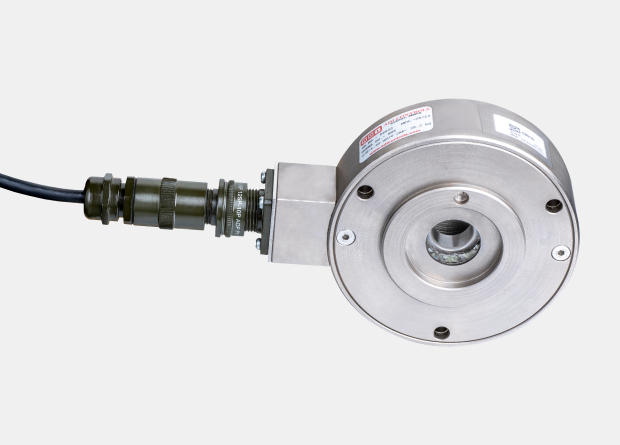
ADI AWS web tension load cell is a specialized sensor designed to measure the running tension in continuous sheet or strand materials, known as a “web.” This is a critical measurement in processes involving the unwinding, processing, and winding of materials like paper, film, foil, textiles, wire, and cable. The load cell is typically mounted beneath or integrated into a idler roller (often called a tension roller or sensing roller). The web passes over this roller. Used for narrow webs or strands, the roller is mounted on a single-end cantilevered beam incorporating the load cell. Maintaining precise web tension is vital for Product Quality: Preventing wrinkles, tears, stretching, or breaking of the material, Process Efficiency: Ensuring accurate registration in printing or coating processes, Winding Control: Creating tightly and evenly wound finished rolls.
Product Type
Single Point Aluminium Load Cell
Usage
Table top scales, Counting and postal scales, Check weighers.
Material
Aluminium
Output
Analog Sensor
Theory
Resistance Sensor
Compensated Temperature
10 To 60 Celsius (oC)
Rated capacity (Kgf)
10, 20, 50, 75, 100, 150
Excitation Voltage
10 V DC – Maximum 15 V DC
Rated Output
1.0 mV/V
Non – Linearity
< ± 0.2 % FSO (Full scale Output)
Hysteresis
< ± 0.02 % FSO
Non-Repeatability
< ± 0.1 % FSO
Creep error (30 minutes)
< ± 0.03 % FSO
Zero Output
± 1.0 % FSO
Input Resistanc e
375 ± 15 Ohms
Output Resistance
350 ± 5 Ohms
Insulation Resistance
>1000 Mega Ohms
Safe Overload
150 % of Rated Capacity
Ultimate Overload
250 % of Rated Capacity
Temperature
Compensated Range
0 to 60° C
Temperature Effect on
Output
< 0.04 % FSO/° C
Temperature Effect on
Zero
< 0.04 % FSO/° C
Deflection
< 0.5 mm at FSO
Finish & Construction
Electroless Nickel Plated Tool Steel
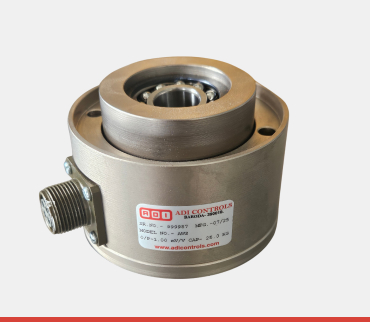
A Web Tension Load Cell is a specialized sensor used to accurately measure the longitudinal force (tension) exerted by a continuous sheet material (the “web”) as it moves through a machine.
Web tension load cells are designed for highly sensitive measurement and are generally integrated into the machine structure at key locations:
These terms primarily refer to the physical mounting style required for different machine designs:
Type | Mounting Style | Typical Use Case |
Pillow Block | Mounted directly on top of the machine frame, with the sensing roll bearing dropping into the cell’s internal cavity. | Easy integration into existing frame structures; high sensitivity. |
Flange Mounted | Bolted from the side or underneath the machine frame using a mounting flange. | Ideal for mounting in confined spaces or where the load must be captured from a specific direction. |
The choice depends on the available space, the orientation of the machine frame, and the total load/speed requirements of the application.
A specialized tension controller or amplifier is mandatory because web load cells are designed to measure tension using the F = T x factor principle (where F is the measured force and T is the actual web tension).
If web tension readings are erratic or incorrect, check these common issues:
WhatsApp us