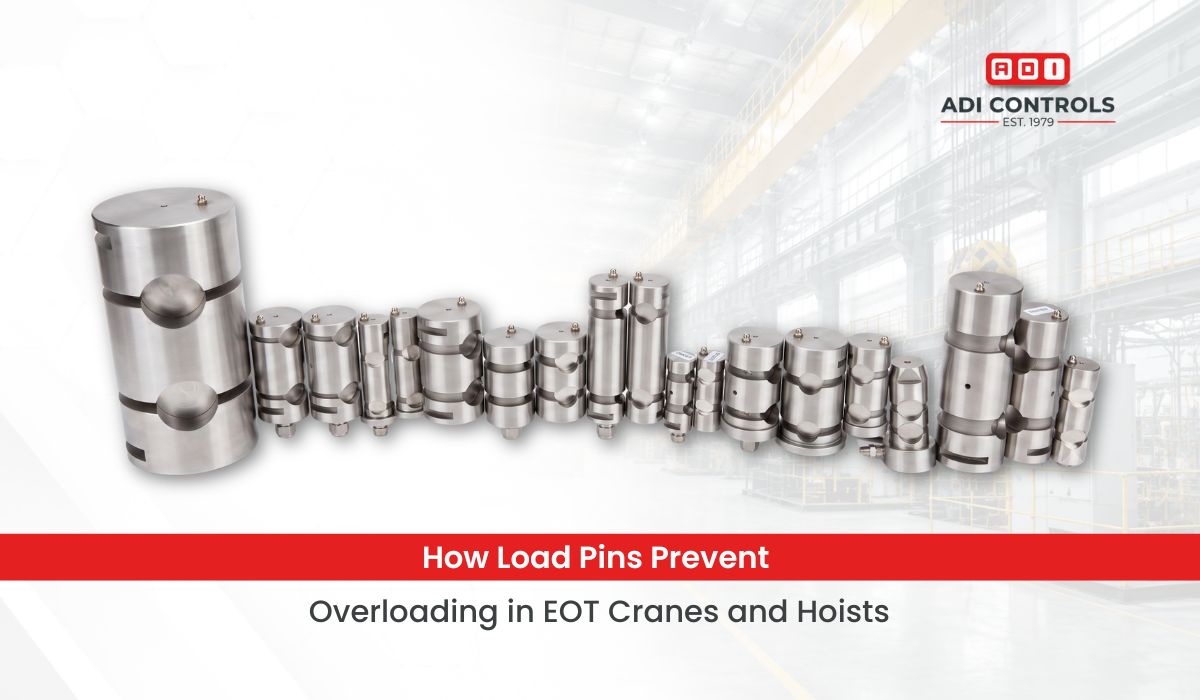
Load pins are important safety components in EOT cranes, hoists, lifting machines, and material handling systems. They help measure the actual load during lifting and send this information to a display, controller, or safety system. When used correctly, they help prevent overloading before it becomes dangerous.
An EOT crane often handles heavy loads in factories, warehouses, steel plants, workshops, and process industries. If the crane lifts more than its rated capacity, the risk increases. The hoist, hook, wire rope, structure, and gearbox may come under stress. In serious cases, this can lead to equipment damage, load drop, or worker injury.
This is why load pins and crane load cell systems are used in modern lifting applications. ADI Controls lists ALP 751 as a Load Pin Load Cell and also lists multiple special load pin options under its special load cell category.
Load pins are force measuring sensors that look similar to standard mechanical pins. They are designed to replace regular pins in areas such as sheaves, shackles, pulleys, pivots, bearing blocks, and hoist mechanisms. Although they look simple from the outside, they contain sensing elements inside.
A load pin usually has strain gauges placed inside the body of the pin. When a load is applied, the pin experiences stress. The strain gauges detect this stress and convert it into an electrical signal. This signal represents the force acting on the pin.
In many cranes and hoists, space is limited. There may not be enough room to install a separate external weighing system. A load pin solves this challenge by replacing an existing pin in the load path. This makes it a practical custom load cell solution for crane safety.
For example, in a hoist sheave assembly, the standard pin can be replaced with a load pin. As the rope carries the load, force is transferred through the sheave and into the pin. The load pin measures that force and sends the signal to the monitoring system.
The signal flow is simple. First, the crane lifts the load. Then force passes through the lifting mechanism. The load pin senses the force. The signal goes to an amplifier, indicator, controller, or PLC. The system compares the measured load with the safe working limit.
If the load is within the allowed range, lifting can continue. If the load approaches the limit, the system can warn the operator. If the load crosses the set limit, the system can stop further lifting or trigger an overload alarm.
Load pins prevent overloading by giving real time load feedback. Operators do not need to depend only on visual judgment or rough estimation. They can see the actual load value and make safer lifting decisions.
Overloading can damage the crane structure and mechanical parts. These notes that overload conditions can stress structural components, cause fatigue, or lead to breakage during operation. These situations create safety risks for both operators and nearby workers.
A crane load cell system can be set with warning and cutoff limits. For example, the first warning may appear when the load is close to the rated capacity. This gives the operator time to take action. If the load keeps increasing, the system can stop the hoist from lifting further.
This type of safety action is useful in EOT cranes, especially when loads are irregular, hidden, or difficult to estimate. A steel bundle, machine part, mold, coil, or container may look manageable, but the actual weight can be higher than expected.
A load pin can be connected to visual alarms, sound alarms, digital indicators, hoist controls, or PLC based safety systems. When the measured force crosses the set limit, the system can alert the operator immediately.
Some crane load cell systems can also store load data. This data helps maintenance teams review lifting patterns, detect misuse, and plan inspections. In smart crane setups, the signal can be used for monitoring and reporting.
Consider an EOT crane used in a fabrication workshop. The crane is rated for a specific lifting capacity. During daily operation, workers lift plates, assemblies, and fabricated structures. Some loads may have uneven weight distribution.
A load pin installed in the sheave or lifting point measures the force during every lift. When the load is safe, the system allows normal operation. When the load is close to the rated limit, an alarm warns the operator. When the load exceeds the safe limit, the hoist up function can be stopped.
This prevents the operator from lifting a dangerous load further. It also protects the crane, hoist, wire rope, and surrounding workers.
Load pins are useful because they fit into existing mechanical points. They do not always require large structural changes. HFN Sensors notes that a custom load pin can be integrated into sheaves, shackles, pivots, and anchoring systems, while providing continuous load monitoring for alarms, displays, control rooms, or PLC systems.
This makes load pins suitable for both new crane systems and retrofit applications. They can improve safety without making the crane design too complex.
Choosing the right crane load cell depends on capacity, pin size, mounting position, load direction, output signal, protection level, and working environment. For outdoor cranes or harsh industrial areas, dust and moisture protection are important. For automated cranes, signal compatibility with PLC or digital display systems is also important.
The load pin must match the crane geometry and load path. If it is not installed correctly, the reading may not represent the actual load. Proper selection, installation, calibration, and maintenance are all essential.
Load pins improve lifting safety by measuring force directly from critical points. They help reduce overload risk, protect equipment, improve operator awareness, and support better maintenance planning.
They are also useful where a standard external load cell cannot be fitted easily. Because load pins can be customized for specific dimensions and capacities, they are practical for many crane and hoist designs.
In modern material handling, safety depends on accurate information. Load pins give operators that information at the right time. This helps prevent overload, reduce downtime, and create a safer lifting environment.
Don’t let overloading put your crane, equipment, and workforce at risk.
Explore ADI Controls load pins and crane load cell solutions built for safer lifting, real time load monitoring, and reliable overload protection.
Load pins send load data to a display or control system. If the load reaches the set limit, the system can trigger an alarm or stop further lifting.
A pancake load cell is thin and disk shaped, while a column load cell is taller and cylindrical. Pancake designs suit low clearance mounting, while column types handle very high capacities.
Load pins are commonly installed in sheaves, shackles, pivots, hoist assemblies, bearing blocks, and other load carrying points.
Load pins are better when the system needs compact integration into an existing pin location. Other crane load cell types may be better for hook based or external weighing setups.
Yes, load pins can often be used in existing cranes if the pin dimensions, capacity, mounting position, and signal requirements are properly matched.
WhatsApp us