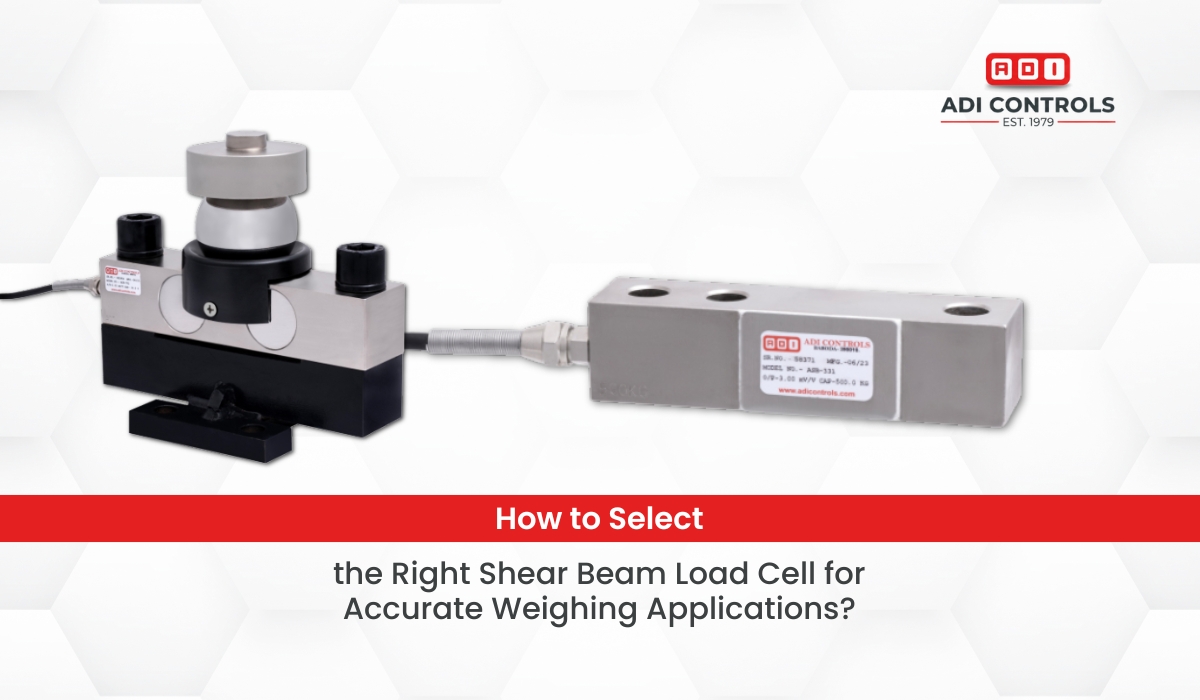
Inaccurate weighing can lead to material loss, process inefficiencies, regulatory non-compliance, and increased operational costs. In industries where precision directly impacts productivity and profitability, selecting the right load cell is critical.
Among the most reliable and widely used solutions in industrial weighing systems is the shear beam load cell. Known for its structural strength and measurement stability, it is commonly used in tank weighing, batching systems, platform scales, and conveyor monitoring.
However, selecting the correct shear beam load cell requires understanding its working principle, configuration types, and application requirements.
Before choosing a load cell, it is essential to understand the fundamentals of shear beam load cell operation.
A shear beam load cell measures force based on shear stress rather than bending stress. When a load is applied, internal shear strain develops within the beam. Strain gauges mounted at carefully calculated positions detect this strain.
As the beam experiences shear deformation, the electrical resistance of the strain gauges changes in proportion to the deformation. This variation is converted into a measurable electrical output signal corresponding to the applied load.
Because the shear strain is concentrated and less influenced by off-centre loading, shear beam load cells offer excellent accuracy and repeatability in industrial environments.
Understanding the shear beam load cell working ensures correct installation and optimal long-term performance.
Choosing between configurations depends on structural design and load capacity requirements.
A single-ended shear beam load cell is fixed at one end while the load is applied at the opposite end.
Common applications include:
These load cells are compact, easy to install, and cost-effective. They are ideal for moderate-capacity applications where proper load alignment can be maintained.
A double-ended shear beam type load cell is supported at both ends, with the load applied at the center of the beam.
It is typically used in:
Double-ended designs provide improved load distribution and structural balance, making them suitable for high-capacity and demanding industrial environments.
Selecting the right shear beam load cell requires evaluating several critical parameters.
1. Maximum and Operational Load- Always calculate the total load, including vessel weight, material weight, dynamic impact forces, and safety factors. Selecting an insufficient capacity can cause overload and premature failure.
2. Structural Design and Load Distribution- Analyze how the load will be transmitted to the load cell. Uneven loading or structural misalignment can affect measurement accuracy.
3. Accuracy and Precision Requirements- Batching and process control applications demand high precision. Ensure the selected load cell meets your required accuracy class and resolution standards.
4. Environmental Conditions- Industrial environments may expose load cells to dust, moisture, vibration, temperature variation, and corrosive elements. Choose a load cell with appropriate environmental protection to maintain long-term stability.
5. Mounting and Installation Accessories- Proper mounting hardware prevents side loads and ensures accurate transmission of force. Incorrect installation can compromise the shear beam load cell’s working efficiency.
6. System Integration Compatibility- Ensure compatibility with weighing indicators, PLC systems, and automation platforms. Stable signal output and calibration support are essential for consistent industrial performance
Due to their mechanical robustness and accuracy, shear beam load cells are widely used across industries.
Common applications include:
Their ability to maintain stable readings under moderate off-center loading conditions makes them highly dependable in industrial weighing environments.
Shear beam load cells offer several performance benefits:
When properly selected and installed, they provide reliable weighing performance for years of operation.
Avoid these common selection errors:
Proper planning ensures consistent and reliable measurement performance.
Selecting the right shear beam load cell is essential for achieving accurate, stable, and long-term weighing performance. By understanding the working principles of shear beam load cells and carefully choosing between single-ended and double-ended configurations, industries can improve operational efficiency and measurement reliability.
For industrial applications where precision cannot be compromised, partnering with an experienced instrumentation provider ensures correct load cell selection, proper installation, and dependable performance over time. ADI Controls offers a comprehensive range of high-quality load cell solutions engineered for durability, accuracy, and seamless integration into modern industrial weighing systems. With proven expertise in force measurement technologies and a commitment to engineering excellence, ADI Controls supports industries across diverse sectors in achieving precise and reliable measurement outcomes.
Accurate weighing begins with choosing the right load cell technology for your specific application requirements, and with the right instrumentation partner, long-term operational success becomes achievable.
A shear beam load cell is a force sensor that measures weight by measuring the shear stress generated under a load. It converts mechanical force into an electrical signal for accurate industrial weighing applications.
The shear beam load cell operates on strain gauge technology. When weight is applied, the beam experiences shear deformation. Strain gauges detect this change and convert it into a proportional electrical signal representing the applied load.
A single-ended shear beam load cell is fixed at one end and loaded at the other, making it suitable for moderate-capacity applications. A double-ended shear beam type load cell is supported at both ends and loaded at the center, making it ideal for heavy-duty tank and silo weighing systems.
Shear beam load cells are widely used in tank weighing, silo monitoring, batching systems, conveyor belt scales, packaging machinery, and platform scales in industrial environments.
WhatsApp us